Friday, March 9, 2012

photography


One project that I really enjoy doing with my 5th grade students is PHOTOGRAPHY. It is one of their favorite lessons as well. We focus on photography as an art form and how important FRAMING is to the compositon. This is a real mind bender to my students because they rarely think of photography as anything but a memory maker. To actually have to THINK about the details in a shot or the position of the camera to create more interest is challenging. Here are a few examples. I will add more so definitly come back and visit!

Textural Still life


One of my 4th grade classes has been working for quite a while on this one project. It was time consuming, but worth it. These still life collages are all about depth, perspective, and TEXTURE! Students were given time to create a drawing of their desired still life. Then, many different types of art media were made available with which to fill in the different objects. These have paint, tissue, patterened paper, silk flowers, cotton balls, and just about anything else they could find in my art room.

5th grade close ups

Some of my 5th grade students were assigned the task of looking closely at different objects. The reason was to notice detail, much like Georgia O'Keefe and her huge flowers. The students were given 18" x 24" paper and were instructed to really enlarge their object, bigger than life (with exception of the trees). Many of them really did a great job.


After School Artists


Above are some beautiful examples of Figure Painting from my after school students.


As promised,above are some of the incredible encaustic paintings done by my afterschool students.

3rd grade landscapes


Mrs. Lipsky's third grade students were learning about landscapes and how depth is achieved on two dimensional surfaces. We discussed what the artist must do to "trick the eye", by making objects appear farther away or closer to the viewer. For these landscapes, the students were to create a reflection. I was impressed how well these students achieved the goal!

Friday, March 2, 2012

Encostic Painting

This is the first time I have tried my hand at teaching students about Encostic Painting. It is actually a very old form of painting, using melted wax. We used melted crayons in a variety of colors. I am doing this with my after school art students, who prove to be my artistic guinea pigs, and they are LOVING IT!

Process: I have had people donate old electric skillets (and I could use a few more). We fill them 1/4 to 1/2 full of water and set them on 250 to 300 degrees. I put a muffin tin in each one and put different colors of crayons in each space. After melting, the students begin filling in their drawing with wax. I have them draw on scrap mat board, because it is heavier than regular paper.

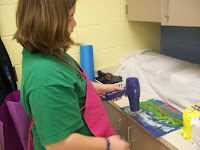
Students can use the hair drying to melt and smooth wax on their boards. This gives those areas a shiny finish.

Can't wait to see them finished! Will share :-)


Wednesday, February 22, 2012

Learning about Illustration and Illustrators

One lesson I like to do with Kindergarteners is one that teaches about the roll of the illustrator. We discuss how the illustrator must work with the author to get a "picture" about what the story is about so that their illustrations help reflect the words.

I use a poem, author unknown, called "Listen My Children", which discribes an imaginary creature, which has not been seen in it's entirety by anyone. The students listen to the poem once without drawing, just to get an idea in their head. Then the poem is read several times over, while the students are drawing their illustration. We even discuss parts of the description and what it actually says, and what it doesn't say. It is really intersting to see what they create.


Friday, February 10, 2012

Study of DEPTH with 3rd grade


Teaching depth on a two-dimensional surface is not always an easy thing to convey to young students. The goal is to get them to understand "portrayed space" and to know how to create the illusion, by placement, size, and color of objects and the foreground, middle ground and backgroud. These 3rd grade students used two art mediums (well, really three) to put togther this composition of fish.
They were able to use the new Crayola color sticks (like colored pencil without the wood) to draw and color in their tropically colored fish on seperate pieces of black paper. They could also do a couple of underwater plants if they wanted. Using cool analogous colors of tempera paint, they painted in their backgournd using lots of overlapping of plants, rocks, etc. Then oil pastels were uses (again, only cool colors) to embellish the background. Fish were cut out of the black paper and glued onto the cool colored background giving an illusion of depth.

2nd Grade Colorful Clay Lizards


This is always a fun project with students. For some reason they all get excited over lizards! This process teaches the coil method of clay handbuilding as well as learning attachment techniques. They really did a nice job!

Wednesday, January 11, 2012

Analogous Color Exercises


These third grade students experimented with ANALOGOUS COLOR. Analogous color is color that is related. They are usually found next to each other on the color wheel. The two most typical analogous color groups are the warm and cool colors. However, those are not the only two. Here we have some students that chose some other groups to use.

Just had to Share


Here are more beautiful Batik pillows. I just want to keep all of them!!!!!!!!!!

Thursday, January 5, 2012

Batik pillows! Awesome!


Two of our 5th grade classes learned a little about the textile art of BATIK. One class used the glue method, where they squeezed glue onto the lines of the design they had drawn, let it dry, painted the design, then soaked the material to get the glue out. Where the glue washed away, the material was left white. The other class used the wax method, where they used melted white crayon to paint on the design, painted with acrylic paint, then we melted off the wax. Again, where the wax was melted off, the material remained white.

Then we really pushed ourselves (or maybe it was me who pushed me) but we decided to turn these into pillows. So, we stuffed and sewed our batiks. They really turned out beautiful!

More Monochromatics


Here are some more beautiful monochromatic paintings by our 4th grade students.

Thursday, December 1, 2011

Beautifully MONOCHROMATIC!


MONOCHROMATIC COLOR SCHEMES are not the easiest way to paint. But these 4th grade students seemed to make it look easy. Monochromatic painting means that you are painting with only ONE color. Now, you may think that they used more, but they have learned that BLACK and WHITE are not actually colors. White is the absence of pigment, and black is the combination of all pigment. Therefore, adding black and/or white to a color to lighten or darken that color, is still painting with only ONE color. Pretty neat, huh?

Why would someone WANT to paint with a monochromatic color scheme????? Well, one reason is that colors illicit different emotions therefore they would more strongly communicate that emotion to the viewer. Another might be that the artist is focusing on that particular skill. Can you think of other reasons?

The RADIALS are rolling in again.


Once again, 2nd grade is learning about RADIAL BALANCE, which is one of the concepts on which they are tested. I have done this project for the last 2 or 3 years, and every year I am amazed at the final pieces these students produce. They not only understand radial balance, but they understand it BEAUTIFULLY!

We look at examples of objects that show Radial Balance. That would be objects reflecting a pattern that begins in the center, and radiates out to the edges. When turned in any direction, you should view the same pattern. Examples would be a flower with a center and petels moving out, a bicycle wheel, a propeller, doilie, just to name a few. What kind of radial balanced patterns do you see around you??????

This year, we made them smaller and glued them onto CD's. I put holes at the top and bottom, connecting a class of Radials together to form a mobile of sorts, to be hung outside their classrooms. They really look great!

It is nice to have a FAN!


It is always nice to have an art fan, but to have a SUPER FAN is even BETTER! This student dressed up as WONDER ARTIST! It is no "wonder", because she IS a super artist! Carry on WONDER ARTIST! Keep up the great work.